




Introduction: When the Body Starts Speaking a Different Language
For many women, menopause announces itself quietly—not through a dramatic moment, but through subtle changes in how the body feels when it moves.
A knee that no longer trusts the stairs. Fingers that ache in the morning before the coffee has even cooled. A shoulder that needs more time, more patience, before it cooperates. These sensations often arrive without injury, without overuse, and without a clear explanation.
At first, they are easy to dismiss. Stress, perhaps. Poor sleep. A demanding week. But as the months pass, these sensations begin to repeat, to cluster, to form a pattern that feels unfamiliar and, for many women, quietly destabilizing.
What makes this experience particularly disorienting is not just the discomfort itself, but the lack of language around it. Joint pain is often treated as mechanical failure. Muscle loss as personal neglect. Stiffness as an unavoidable tax of aging.
In recent years, however, a more integrated explanation has begun to take shape—one that connects these experiences not to decline, but to adaptation. That framework is known as the Musculoskeletal Syndrome of Menopause (MSM).
Core Concept Explanation
What the Musculoskeletal Syndrome of Menopause Means
For many women, the first sign that something has changed does not come from a hot flash or a missed period. It comes from the body in motion.
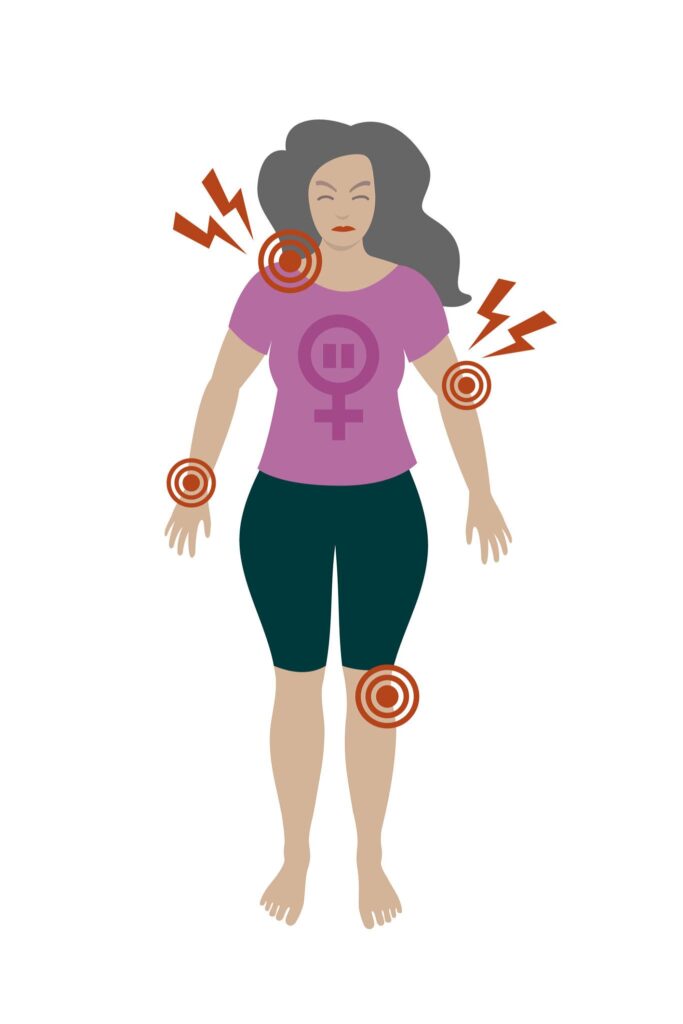
A knee that feels unreliable when standing up from the floor. Fingers that ache in the morning for no obvious reason. A shoulder that takes longer to “warm up” than it used to. These sensations are often subtle at first—easy to dismiss, easy to explain away. But over time, they begin to cluster, forming a pattern that feels unfamiliar and, for many women, quietly unsettling.
The Musculoskeletal Syndrome of Menopause (MSM) is a framework designed to make sense of that pattern.
It refers to a constellation of physical changes that frequently emerge during perimenopause and postmenopause, including increased joint pain or stiffness, reduced muscle mass and strength, tendon and ligament discomfort, slower recovery from physical activity, and a growing hesitation or lack of confidence in movement itself.
What makes MSM distinct is not the presence of any single symptom, but the way these symptoms appear together, often without a clear injury, diagnosis, or mechanical explanation. This clustering reflects systemic shifts in tissue biology, not isolated joint damage or simple “wear and tear.”
At the center of these shifts is estrogen—a hormone often discussed narrowly in reproductive terms, but one whose influence extends deeply into the musculoskeletal and nervous systems.
Estrogen receptors are present in cartilage cells, bone tissue, skeletal muscle, tendons, ligaments, and multiple regions of the nervous system involved in pain perception and motor control. In practical terms, this means estrogen helps regulate how tissues hydrate, how they repair, how they tolerate load, and how safe movement feels to the brain.
When estrogen signaling begins to fluctuate and eventually decline, these tissues do not suddenly break. Instead, they adapt. Cartilage becomes less resilient to repeated stress. Muscle responds less efficiently to training signals. Tendons may stiffen. The nervous system may become more protective, amplifying discomfort as a precaution.
Without context, these adaptations can feel alarming. With understanding, they become interpretable signals, not threats.
Why MSM Is a Framework, Not a Diagnosis
MSM is intentionally described as a framework rather than a diagnosis because its purpose is not to label women or reduce their experiences to a single condition.
Instead, it serves three essential functions.
First, integration. Women are often sent down separate paths for joint pain, muscle loss, fatigue, or reduced mobility, as if each issue exists in isolation. MSM reconnects these experiences, recognizing that they often arise from the same hormonal and systemic transition.
Second, validation. Joint pain during menopause is frequently minimized or dismissed. The MSM framework affirms that these sensations are biologically grounded, not imagined, exaggerated, or purely psychological.
Third, guidance. By understanding the underlying drivers, women can make more appropriate choices about movement, recovery, and daily habits—choices that support adaptation rather than fighting it.
Perhaps most importantly, MSM helps shift the internal dialogue from “What’s wrong with my joints?” to “How is my musculoskeletal system changing, and how can I support it?” That shift alone often reduces fear and restores a sense of agency.
Why This Becomes Relevant After 40
Biological Factors
The menopause transition does not begin at menopause. For many women, biological changes start years earlier, during perimenopause, when estrogen levels fluctuate unpredictably before declining more consistently later on.
These fluctuations influence musculoskeletal tissues in layered ways. Cartilage metabolism slows, subtly altering lubrication and shock absorption. Muscle protein synthesis becomes less efficient, making it harder to maintain strength even with familiar routines. Tendons and ligaments may change their collagen turnover, increasing stiffness or sensitivity. At the same time, estrogen’s modulatory effect on inflammation weakens, allowing inflammatory signaling to rise more easily.
Crucially, these changes do not happen overnight. They accumulate gradually, often beginning long before menopause is clinically defined. This slow progression is one reason symptoms are so often misattributed to stress, aging, or bad luck.
Lifestyle Factors
Biology does not operate in a vacuum. Midlife often brings overlapping stressors that place additional load on the musculoskeletal system.
Career demands may peak just as recovery capacity begins to narrow. Caregiving responsibilities—whether for children, aging parents, or both—reduce time for rest. Sleep disruption becomes more common, sometimes due to hormonal changes, sometimes due to life itself. Recovery time shrinks, even as demands increase.
These pressures amplify musculoskeletal sensitivity by raising baseline inflammation and reducing tissue repair efficiency. The body is not failing; it is operating under sustained load.
Movement & Recovery Factors
Many women continue exercising exactly as they did in their thirties, assuming consistency equals resilience. But hormonal transitions change how tissues respond to load.
High-impact or repetitive movement may feel harsher. Recovery windows lengthen. Muscle loss reduces the natural cushioning and stabilization that once protected joints. Without adjustment, this mismatch can quietly reinforce pain and avoidance rather than strength and confidence.
The issue is rarely movement itself—it is unchanged movement in a changed body.
What’s Considered Normal
Normal menopause-related musculoskeletal changes include mild to moderate joint stiffness, reduced tolerance for repetitive strain, slower strength gains, and an increased need for warm-up and recovery.
These changes reflect biological recalibration, not structural breakdown.
When This May Deserve Attention
Greater attention may be warranted when joint pain begins to limit daily activity, stiffness persists despite gentle movement, muscle weakness progresses rapidly, or fear of movement begins to shape behavior.
These signals suggest that adaptation is occurring faster than supportive strategies are being applied—not that the body is irreversibly damaged.
What Research Suggests Actually Helps
Strength as Hormonal Support
Strength training becomes particularly important during menopause because it preserves muscle mass, stabilizes joints, improves neuromuscular coordination, and supports metabolic health. Strength does not need to be aggressive to be effective—it needs to be consistent and progressive.
Movement Quality Over Intensity
Joint tissues during menopause respond best to controlled ranges of motion, gradual loading, and reduced impact variability. Quality-focused movement restores confidence by teaching the nervous system that movement is safe again.
Recovery as a Primary Strategy
Sleep disruption is common during menopause. Supporting recovery through regular sleep timing, stress modulation, and appropriate training volume reduces inflammatory load and supports tissue repair.
The 2026 Shift in HRT Framing (Contextual, Not Prescriptive)
Recent guidance has reframed hormone therapy discussions around ovary-span and quality of life, explicitly including musculoskeletal health. This shift reflects a broader recognition that mobility is central to aging well.
This article does not advocate for or against therapy. It simply acknowledges that joint health is now part of the menopause conversation, not an afterthought.
Common Misconceptions
Joint pain does not mean arthritis is inevitable. Avoiding strength training often accelerates instability. Stretching alone rarely resolves stiffness. Pain does not automatically indicate damage—hormonal adaptation can increase sensitivity without injury.
Long-Term Perspective
MSM reframes menopause as a transition of tissue behavior, not decline. With informed movement, adequate recovery, and strength preservation, many women regain comfort, capability, and confidence.
Joint health after menopause is not about fragility. It is about supporting adaptation over time.
Frequently Asked Questions
Is the Musculoskeletal Syndrome of Menopause officially recognized?
MSM is an emerging framework rather than a formal diagnosis. Its value lies in integration—connecting symptoms that were long treated separately under a shared biological explanation.
Does every woman experience joint pain during menopause?
No. Menopause is not uniform. Genetics, lifestyle, muscle mass, sleep quality, and stress all shape how tissues respond. The absence of pain does not invalidate the framework, just as the presence of pain does not imply pathology.
Can mobility improve after menopause?
Yes—often significantly. Many women regain strength, stability, and confidence once movement, recovery, and expectations align with their current biology.
Why does joint pain appear even when imaging looks normal?
Pain does not always correlate with structural damage. Hormonal changes influence tissue hydration, nerve signaling, and pain sensitivity, sometimes without visible changes on imaging.
Is this the same as arthritis?
Not necessarily. Menopause-related musculoskeletal changes can exist with or without arthritis. Assuming all pain equals disease often leads to unnecessary fear.
Should high-impact exercise be avoided?
Not automatically. Some women tolerate it well; others benefit from modification. The key question is responsiveness, not prohibition.
Why is stiffness worse in the morning?
Hormonal shifts influence overnight inflammatory signaling and tissue hydration. Morning stiffness that improves with movement often reflects timing rather than damage.
Is stretching enough?
Stretching may feel good, but without strength and control, stiffness often returns. Stability supports mobility.
Does fear of movement matter?
Yes. Unexplained pain often leads to avoidance, which can reinforce weakness and sensitivity. Understanding restores confidence.
Is it too late after menopause?
No. Adaptation remains possible well beyond menopause. What changes is the approach, not the capacity.
Final Perspective
The Musculoskeletal Syndrome of Menopause gives language to experiences women have long felt but rarely had explained. Understanding the estrogen–muscle–joint connection replaces fear with clarity and restores agency.
Menopause changes the rules—but it does not remove women from the game.
Editorial Disclaimer
This article is for educational purposes only. It does not diagnose, treat, or recommend medical interventions. Individual experiences vary, and readers should consult qualified professionals regarding persistent symptoms.